
Foundations transfer all the weight of a building safely into the ground. Get them wrong and everything above them cracks, sinks or fails. Getting the right concrete — in the right grade, depth and volume — is critical.
What grade of concrete for foundations?
The right grade depends on the type of foundation and the loads it will carry:
- C15 / GEN1: Blinding layer under a slab — not structural
- C20 / GEN2: Light unreinforced foundations, garden buildings
- C25 / GEN3: Standard domestic strip footings for a house extension
- C30: Slightly heavier loads, garage foundations
- C35 / RC35: Reinforced foundations, commercial structures, heavy loads
- C40 and above: Multi-storey commercial, industrial buildings
See our full concrete grades explained guide for a complete breakdown.
Foundation types
Strip foundations
Continuous strips of concrete supporting load-bearing walls. Standard for most domestic extensions and self-builds. Typically 600mm wide × 250mm deep for a cavity wall.
Trench-fill foundations
Deep trenches poured full of concrete. Simpler than strip footings because the concrete replaces most of the brick or block below ground. Common on shrinkable clay sites.
Raft foundations
A single large slab spanning the whole building footprint. Used on poor ground where strip footings would sink unevenly.
Pad foundations
Isolated pads supporting individual columns — for steel-frame buildings, timber-frame houses on posts, or decking.
How deep should foundations be?
UK Building Regulations set minimum depths:
- 500mm — minimum on very stable, non-shrinkable ground
- 750mm — standard depth on average sites
- 1000mm+ — minimum on shrinkable clay soils
- Deeper — near trees, high water tables, poor soils
Your building control officer will confirm the depth required for your specific site.
How much concrete do I need for foundations?
Foundation concrete volume is calculated as:
Length (m) × Width (m) × Depth (m) × Number of runs = m³
Example: An 8m × 4m extension needs strip footings around all four sides plus one internal run — total 26m of trench, 0.6m wide × 0.75m deep:
26 × 0.6 × 0.75 = 11.7 m³
With volumetric concrete you don’t have to be exact. Order the calculated volume; if the trench needs more we’ll keep mixing, if it needs less we stop. You pay only for what’s used. Use our concrete calculator to work out yours.
Ordering foundation concrete
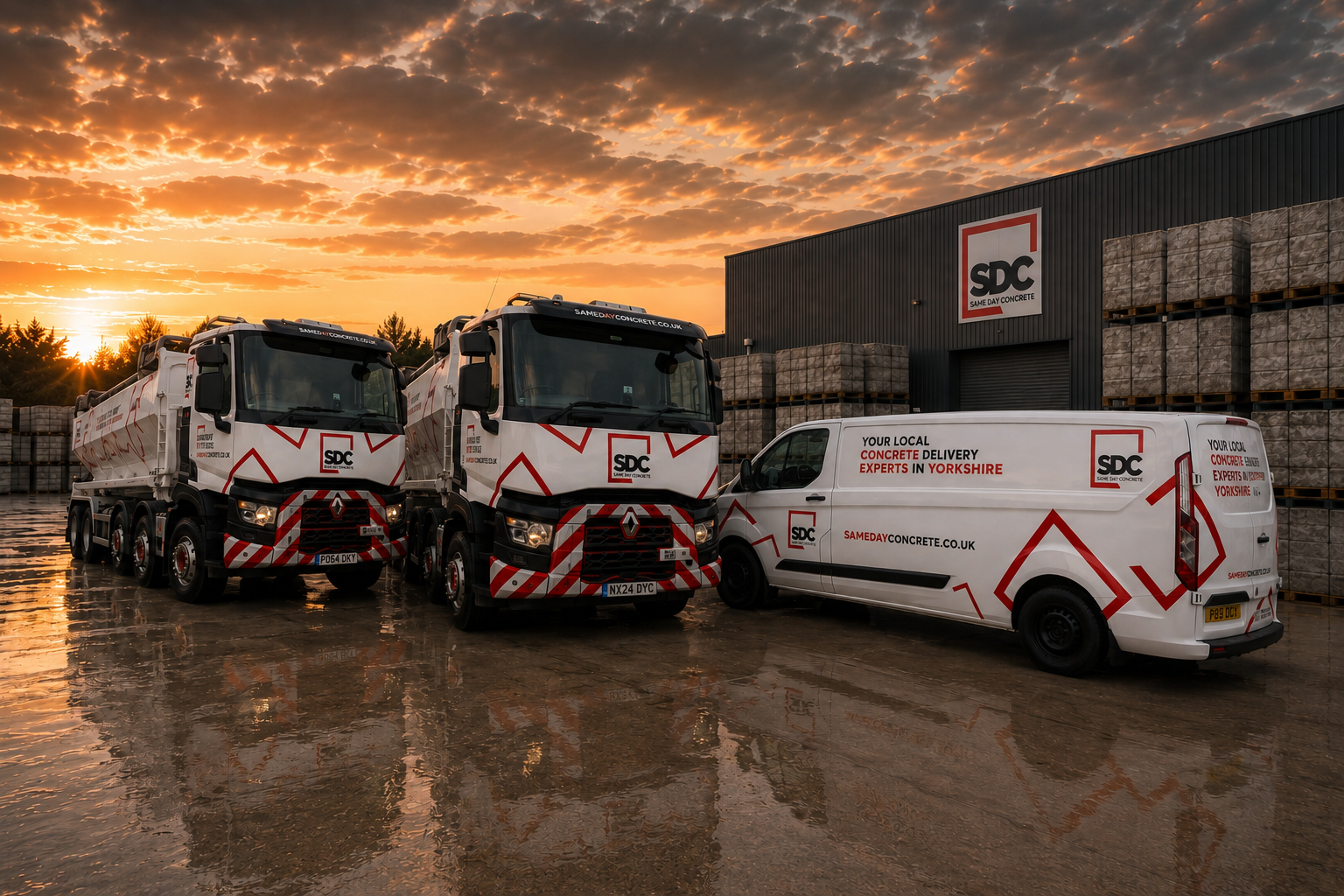
Same Day Concrete supplies foundation-grade concrete across the whole of Yorkshire including Wakefield, Leeds, Bradford, Huddersfield and Halifax. Same-day delivery available.
Ready to order? Get an instant quote or call 01924 910 129.
FAQs
What is the best concrete grade for foundations?+
C25 or C30 is standard for most domestic foundations. C35 or RC35 is used where reinforcement is required or heavier loads are expected. Always confirm with your structural engineer or building control officer.
How deep should foundations be?+
UK Building Regulations require foundations at least 1m deep on shrinkable clay soils, 750mm on average sites, and 500mm minimum on very stable ground. Trees, water tables and soil type can require deeper.
How wide should a strip foundation be?+
Strip footings for domestic walls are typically 600mm wide for cavity walls and 450mm for single-skin walls. Wider footings may be required for softer soils.
Do I need building control approval for foundations?+
Yes — any structural work in the UK requires building control inspection. Your building control officer will inspect the trench before you pour.